
What are Florida's salon towel and linen rules?
DBPR rules, towel math, oil safety, and how to stop throwing away stained towels.
A practical guide for salon, barbershop, and spa owners in Hialeah and greater Miami-Dade.
On this page
Most salon owners in Hialeah are still doing their own laundry.
Not because it makes sense. Because it started as one load between clients, and now it's a house washer running all day, a stylist folding towels instead of taking a walk-in, and somebody staying until 9pm on a Saturday to get the color towels done for Sunday.
This guide covers the four things that actually go wrong with salon and spa linens, what Florida requires of you, and how to figure out whether handling it in-house is still worth it.
What Florida actually requires
Start here, because this is the part that costs you on an inspection and almost nobody reads it.
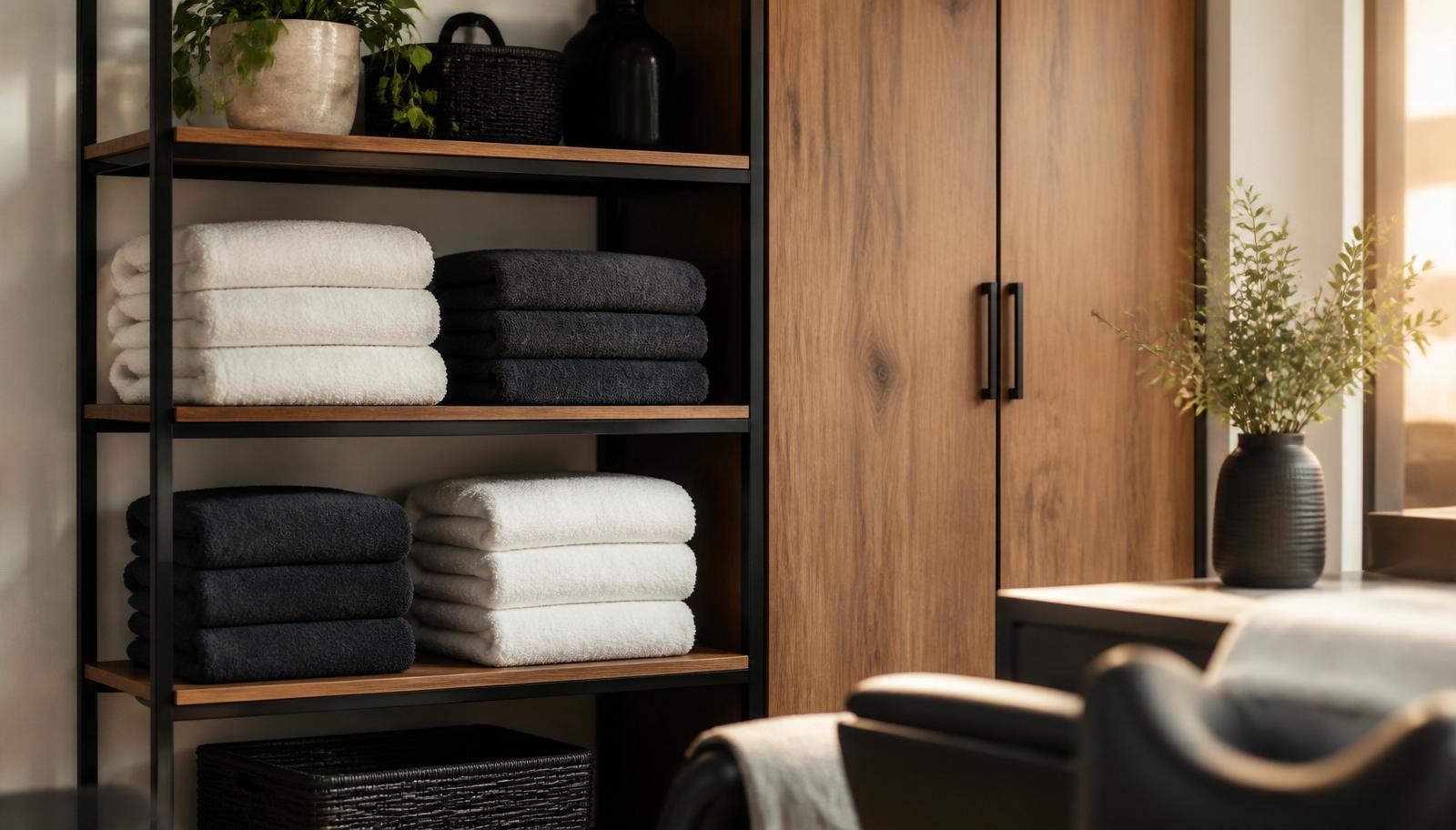
Florida Administrative Code rule 61G5-20.002 governs salon requirements. The linen section is short and specific. Clean linens have to be kept in a closed, dustproof cabinet. Soiled linens have to go in a closed receptacle. You can use an open container for soiled linens only if it's completely separated from the area where you're servicing clients.
There's also a rule most people miss: a sanitary towel or neck strip has to go around the client's neck so the shampoo cape never touches their skin directly.
The DBPR inspection form checks these. Two of the most common linen-related citations are storing clean towels somewhere that isn't a closed cabinet, and leaving used towels in an open bin at the station.
What this means in practice:
- An open shelf of clean folded towels behind the styling chairs is a finding, however clean the towels are
- A wheeled open hamper next to the shampoo bowl is a finding
- Clean and dirty linens sharing a storage area is a finding
- Running out of neck strips mid-day and skipping them is a finding
None of this is expensive to fix. A closed cabinet and a lidded hamper solve most of it. The reason it keeps showing up on inspection reports is that in-house laundry blurs the line: when you're washing on-site, clean and dirty linens live in the same room, and the closed-container discipline slips.
Quick self-audit
Walk your floor right now and answer three things.
If any answer is no, that's a 20-dollar fix and a Saturday morning.
Towel math: how many you actually need
Most salons are chronically short on towels and don't know it, which is exactly why the washer runs all day.
The industry rule of thumb is par level: how many complete sets of an item you keep in circulation. One par is what you use in a day. You need enough par that some towels are in use, some are dirty, and some are clean and ready, all at once.
How many do you actually need?
Towels, capes, neck strips and aprons.
About 180 clients a week at six days open.
The working floor for most shops.
Every day, same day.
Hair towels in circulation, split across the three states of a working par.
| Item | Per client | Used daily | Keep on hand |
|---|---|---|---|
| Hair towels | 2 | 60 | 180 |
| Capes | 1 | 30 | 60 |
| Cloth neck strips | 1 | 30 | 90 |
| Staff aprons | 0.12 | 4 | 12 |
Based on 30 clients a day at 3 par, washing daily. Rounded up to the nearest half dozen, because that is how towels are sold. The hours figure assumes about 45 seconds of handling per piece across sorting, loading, folding and shelving.
We collect on a fixed window and return towels folded, capes hung, ready to shelf.
Get a weekly quote →Why 3 par is the floor. At 2 par you have one set in use and one set in the wash, which means a single broken dryer shuts down your service day. At 3 par you have a buffer. At 4 par you can move to a twice-weekly laundry schedule instead of daily, which is usually where the labor savings actually show up.
Running short isn't just inconvenient. It's the root cause of the two problems in the next sections. Short inventory means rushed wash cycles, overloaded machines, and towels going back into service damp.
Why your towels are stained and crunchy
Three things kill salon towels, and only one of them is the color.
Fabric softener. This is the big one. Softener leaves a waxy residue that coats the terry loops. Coated towels stop absorbing water, which is the entire job of a towel. Then they trap oils and product instead of releasing them, which makes them smell. Stop using softener on salon towels. If you want them soft, that comes from proper drying and not overloading the dryer.
Wrong water temperature. Color and bleach need heat and the right chemistry to lift out. Cold washes set the stain. But scalding hot water on every load breaks down the fibers faster than the chemicals do. There's a working range, and most home machines don't hit it reliably.
Letting stains sit. A color towel that sits in a hamper overnight is a different problem than one washed within a few hours. Dye oxidizes and bonds to the fiber. Once it's set, it's set.
On bleach-resistant towels: they're worth buying, but understand what they do. They're engineered so the dye in the towel survives chlorine bleach, which lets you sanitize aggressively without the towel turning orange. They don't stop hair color from staining. You still need proper wash chemistry to lift the dye out.
If you want to test whether your current towels are bleach-safe before you commit to a wash process, there's a simple check: mix a couple teaspoons of bleach into a quarter cup of water, dab a drop somewhere hidden like under the care label, wait a minute, then blot dry. No color change means you can bleach them.
What actually works:
- No fabric softener, ever, on towels
- Sort by color, and keep color towels separate from white
- Wash the same day, not the next morning
- Pre-treat with an enzyme product rather than scrubbing
- Dry fully, then get them out of the dryer
Why they smell, and why it's worse in Miami
Musty towels are a moisture problem, and South Florida makes it harder than almost anywhere else in the country.
The smell is bacteria and mildew living in fibers that never fully dried. A towel that sits damp in a hamper, or comes out of a home dryer at 90% dry and gets folded and stacked, keeps just enough moisture to grow. Then you stack it in a closed cabinet, which is what the state requires, and the cabinet does exactly what a closed cabinet does.
Our humidity means towels air-dry slower, hampers stay wetter, and the margin for error on drying is thinner than it would be in a dry climate.
Detergent buildup makes it worse. Overloading the washer means detergent doesn't rinse out, and the residue holds onto oils and odor instead of releasing them. Most people respond to smelly towels by adding more detergent, which compounds the problem.
The reset, if your towels already smell:
- Wash on the hottest setting the towel can take with about a cup of white vinegar, no detergent
- Run a second cycle with half a cup of baking soda (don't combine the two in one load)
- Dry completely, low and slow, then unload immediately
- Clean the washer itself: a hot empty cycle with vinegar, and wipe the door gasket on a front loader
The prevention: don't overload, don't over-detergent, don't leave wet loads sitting, and dry fully. Simple in theory. Hard when a stylist has to remember it between clients.
The one for spas: massage oil is a fire hazard
This section matters more than the other four combined, and most spa owners have never been told.
Massage oil in linens can spontaneously combust in a dryer. Not the oil bottle. The sheets.
Here's the mechanism. Many common essential oils are classified as Class 3 flammable liquids. Tea tree, lavender, and citrus oils have flash points around 122 to 140°F. Orange, rosemary, bergamot, chamomile, eucalyptus, grapefruit, lemon and others sit between roughly 102 and 130°F.
Most dryers on low heat run around 125°F. Medium to high runs about 135°F.
Those ranges overlap.
Residual oil left in a sheet after washing can oxidize, generate its own heat, and if that heat can't escape, it climbs until it ignites. This is called thermal runaway. It's a documented cause of laundry fires and insurers publish guidance on it.
The conditions that cause it are ordinary spa operations:
- Oily linens crammed tightly into a bag or bin, where the center can't shed heat
- Linens left in a hot car
- A finished dryer load left sitting overnight to fold in the morning
- Washing at too low a temperature, so the oil never fully breaks down and washes out
That last point is the one that catches people. Oil needs to get hot enough to combine with detergent and release from the fiber. Insurance loss-control guidance puts the minimum wash temperature at 104°F. Below that, the oil doesn't leave the sheet. It just becomes invisible.
If you're washing spa linens in-house, do these:
- Wash oily linens the same day. Don't store soiled linens for days
- If you must hold them, store loosely in a metal container with a self-closing metal lid, away from other combustibles
- Wash at 104°F or above so the oil actually releases
- Dry on low, below 125°F
- Never leave a finished load sitting in the dryer
- Take linens out of the dryer and either fold them or spread them out loose, not crammed into a basket
- Keep the lint trap clean
A visibly clean sheet can still hold enough oil to be a problem. That's the part that makes this hard to manage with a home machine and a busy front desk.
What in-house laundry actually costs
The washer was already there, so it feels free. It isn't.
Here's a conservative model for a mid-size salon doing about 30 clients a day. Adjust the numbers to your own shop.
| Line item | Assumption | Annual |
|---|---|---|
| Labor | 1.5 hrs/day at $15/hr, 6 days/wk | ~$7,000 |
| Utilities | Water, gas, electric on daily loads | $900 to $1,800 |
| Supplies | Detergent, bleach, stain treatment | $400 to $700 |
| Equipment | Machine wear, repairs, amortized replacement | $600 to $1,200 |
| Towel replacement | Higher rate from home-machine wear and set stains | $500 to $1,000 |
| Total | ~$9,400 to $11,700 | |
The labor line is the one people underestimate. It isn't only the time. It's that the time comes out of a stylist who could be finishing a client, or out of the owner's evening.
And the biggest number isn't on the table: the revenue from the walk-in nobody could take because a stylist was in the back loading the washer.
Run your own version. If your labor number is small because you're doing it yourself after hours, that's a real answer. Just be honest that you're paying for it in hours rather than dollars.
If you outsource, what to ask
Not every laundry service is set up for salon and spa work. Ask these before you sign anything.
Do you sort and process our linens separately? Salon towels shouldn't be washed with restaurant aprons. Ask directly.
What's your process for color and bleach stains? A generic wash-and-fold operation will hand back the same stained towels. You want to hear about pre-treatment and dye-lifting chemistry.
Can you handle oil-saturated spa linens? This is the question that separates a real commercial operation from a laundromat with a van. Ask about wash temperature and drying protocol.
What's the turnaround, and is it fixed? You need a schedule you can build a par level around. “Usually two days” is not a schedule.
Do you return capes hung and towels folded, ready to shelf? If your staff has to re-sort and re-fold, you didn't save the labor.
What happens if a pickup is missed? Get the answer before it happens.
Is pricing flat or by weight, and what happens in a busy month? You want a number you can put on the P&L.
How we handle it
We run commercial accounts for salons, barbershops, spas and massage studios across Miami-Dade and Broward, out of our facility on West 4th Avenue in Hialeah.
The setup is simple. We look at your weekly volume and set a fixed pickup window, weekly or twice-weekly. We swap your bins on that window. Towels come back folded and capes come back hung, sorted and ready to go straight into a closed cabinet. Delivered the next morning, before your first client sits down.
Color towels get pre-treatment and dye-lifting chemistry so bleach and color don't set over time. Spa linens are processed at temperature and dried properly, because of everything in section 5. Pickup and delivery are free across Miami-Dade and Broward.
Pricing is flat and weekly, so it's a line you can budget.
Tell us your rough weekly volume and we'll come back within one business day with a real number and a start date.
Common questions
We also serve:
The Launderette Lounge is a full-service laundry and dry cleaning facility in Hialeah, serving commercial accounts across Miami-Dade and Broward County.